
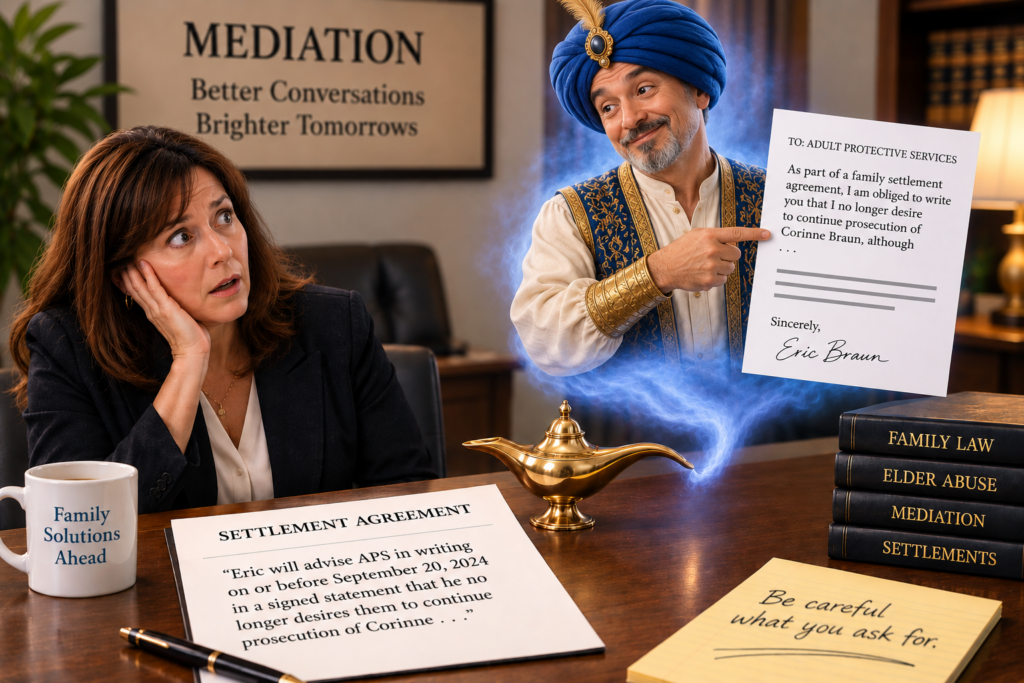
“Be careful what you ask for.” Your mother probably said that (or “be careful what you wish for”) dozens of times. Your high school, college and work friends say it all the time.
A recent Arizona Court of Appeals case caught our eye because of what the parties had asked for. We might say that the lesson of this case is a variant: pay attention to what you asked for.
Michele Braun’s children and her estate
Michele Braun did her estate planning decades before her death. She signed a living trust in 1993 and died late in 2023 — at age 101. After her death, her three children began to squabble about her estate.
The appellate court’s decision doesn’t actually describe the family disagreement. We can imagine, based on many other family feuds we have seen, what might have happened. Maybe Ms. Braun transferred assets to one of her children before her death. Maybe one of the children used her accounts after her death, without authority. We don’t know, and we decline to speculate about specifics. But what is clear is that the family fight was serious.
How do we know it was serious? Because son Eric apparently made a referral to Adult Protective Services, accusing daughter Corinne of elder abuse, neglect and/or exploitation. Even the details of that referral are unknown from the court decision.
We often see just this family dynamic. Shortly before or after a parent’s death, the children begin to believe that their siblings have taken advantage, abused or just plain stolen from the parent.
Mediation and settlement
However the charges and counter-charges developed, the Braun children did what we always recommend. They participated in a family mediation. And they seemed to have settled their differences.
We don’t know whether transactions were unwound or approved. We also don’t know whether anyone was required to return funds, or pay costs or damages. But what we do know is that Eric Braun agreed to write a letter to Adult Protective Services. The precise language of that part of the agreement was:
“Eric will advise [Adult Protective Services (APS)] in writing on or before September 20, 2024 in a signed statement that he no longer desires them to continue prosecution of Corinne although the parties understand that the ultimate decision is for APS to make.”
Then the siblings all signed. And Eric promptly wrote to Adult Protective Services:
“As part of a family settlement agreement, I’m obligated to write you that I no longer desire APS to continue prosecution of Corinne Braun, although the parties know and understand that the ultimate decision is for APS to make, based on your mission, your duties and your obligations to curtail elder abuse and exploitation in Arizona and to honor the victims.”
Back to court
Corinne Braun quickly cried foul. That letter, she argued, did not comply with the spirit or the terms of the settlement agreement. She asked the probate judge to rescind the agreement, which would let the siblings return to court to wrestle over the underlying claims and counterclaims. And she issued a slew of subpoenas for her brothers’ phone records, apparently hoping to show that they had been communicating with APS for years.
Wait a minute, said the probate judge. Eric’s letter might not be the way you wanted it worded. But it was what you asked for. The judge ruled that Eric’s letter satisfied the settlement agreement.
The settlement agreement also included a provision about attorney’s fees. It said that anyone who had to go to court to “enforce, interpret or otherwise obtain judicial or quasi-judicial relief in connection with” the agreement would be entitled to collect their legal costs, attorney’s fees and expenses. Eric asked the probate judge to order Corinne to pay for his costs and attorney’s fees. But the probate judge denied that request, without explaining its reasoning.
…and on to the Court of Appeals
Corinne appealed the denial of petition to rescind the agreement. And Eric and their brother Mark cross-appealed, asking for an award of attorney’s fees for her probate court petition. Both sides asked the Court of Appeals to award attorney’s fees and their appeal costs.
The Arizona Court of Appeals, in a “memorandum” decision (not published and therefore not legally precedential), agreed with Eric and the probate judge on the merits. Eric’s letter to APS, they agreed, was what Corinne had asked for. The fact that it hinted broadly that he thought prosecution should continue was of no moment. The letter might not have sounded very sincere, but if you want a sincere letter then that is what you ask for.
The Court of Appeals also agreed with Eric and Mark about the attorney’s fees. They had been successful in the probate court, ruled the appellate judges, and the agreement mandated an award of attorney’s fees. Furthermore, it mandated an award of fees and costs associated with the appeal, too. Estate of Braun; Braun v. Braun, August 26, 2026.
What the Braun decision tells us about family feuds
We see too many family feuds arising from the death of a parent. Sometimes they come from deaths of other family members. Occasionally they pop up after a family member becomes incapacitated, or maybe just vulnerable. But they tend to share some common characteristics.
First, they are almost always extremely bitter. We have seen scorched-earth litigation over the division of personal property worth no more than a few thousand dollars. Too often we have seen family members so incensed that they refuse to engage, respond or negotiate with their estranged family members.
Second, the cost of litigation in family disputes is almost always out of proportion to the amount, or value of property, at issue. That does not seem to deter family members who are fixed on retribution, or on their concept of justice.
Third, they almost always involve arguable facts. Your father loved you equally, and wanted everything divided into equal shares? Funny, your brother insists that he thought you had already gotten more than your share during his life, and that’s what he told family friends. Or his lawyer. Or your brother’s lawyer. The point is: the facts are almost always flexible, and the parties usually genuinely believe they have the truth on their side.
That’s why we so strongly encourage mediation. The only people who will benefit from protracted family fights are the lawyers. And even we lawyers will take a beating, as we feel so sorry for you that we cut fees or do extra work for no additional fee. Or we reduce our fees as one way to get you to settlement. In other words, we don’t love your family fight either.
But in negotiating settlement of your family fight, we do have a couple of suggestions. Make sure you’re getting everything settled. Don’t leave unresolved issues out there. But be careful what you include. And then pay attention to what you asked for.



One Response
Unless your goal is to tear your family apart, I would encourage parents to share their will or trust with all children at the time of its creation, and any time it is updated. This was not done in our family and it resulted in a 15 year family rift that will never be completely healed. We know what the original will said, but were never given any updates, although it would appear that at least 5 updates were made. This resulted in one sibling inheriting approximately 97% of the estate, and the other sibling getting a small flat sum. There was no estrangement, or any particular reason that we knew about, and it came as a total shock. Yes, the benefactors could have done the right thing, but they clearly knew this was coming and never said anything, and of course settled on the “It was his money to do with as he pleased” excuse. This is of course true. But how would YOU feel in such a circumstance? Please, do not do this to your family.